- info@srhworld.com
- +91 (20) 24616106 | Helpline : +91 84849 14844
Understanding Credit Ratings for Bonds & NCDs
Navigating the world of investments can often feel difficult, especially when terms like credit ratings come into play. However, understanding these ratings is crucial, even more so when considering to invest in Bonds and Non-Convertible Debentures.
A credit rating is an independent expert’s opinion on how reliable a company or a government entity is when it comes to repaying its debt like Bonds and NCDs. It’s a professional assessment of their financial health and their likelihood of defaulting on their promises. In India, this assessment is done by specialised organisations known as Credit Rating Agencies. Some of the prominent ones are CRISIL, ICRA, CARE Ratings and India Ratings and Research. Their job is to:
• Analyse the borrower’s financial statements, business operations, management quality and overall outlook thoroughly.• Assess risk based on the comprehensive analysis and form opinion on the probability of default
• Assign a rating – this opinion is then translated into a standardized letter grade which acts as an indicator of the investment’s safety.
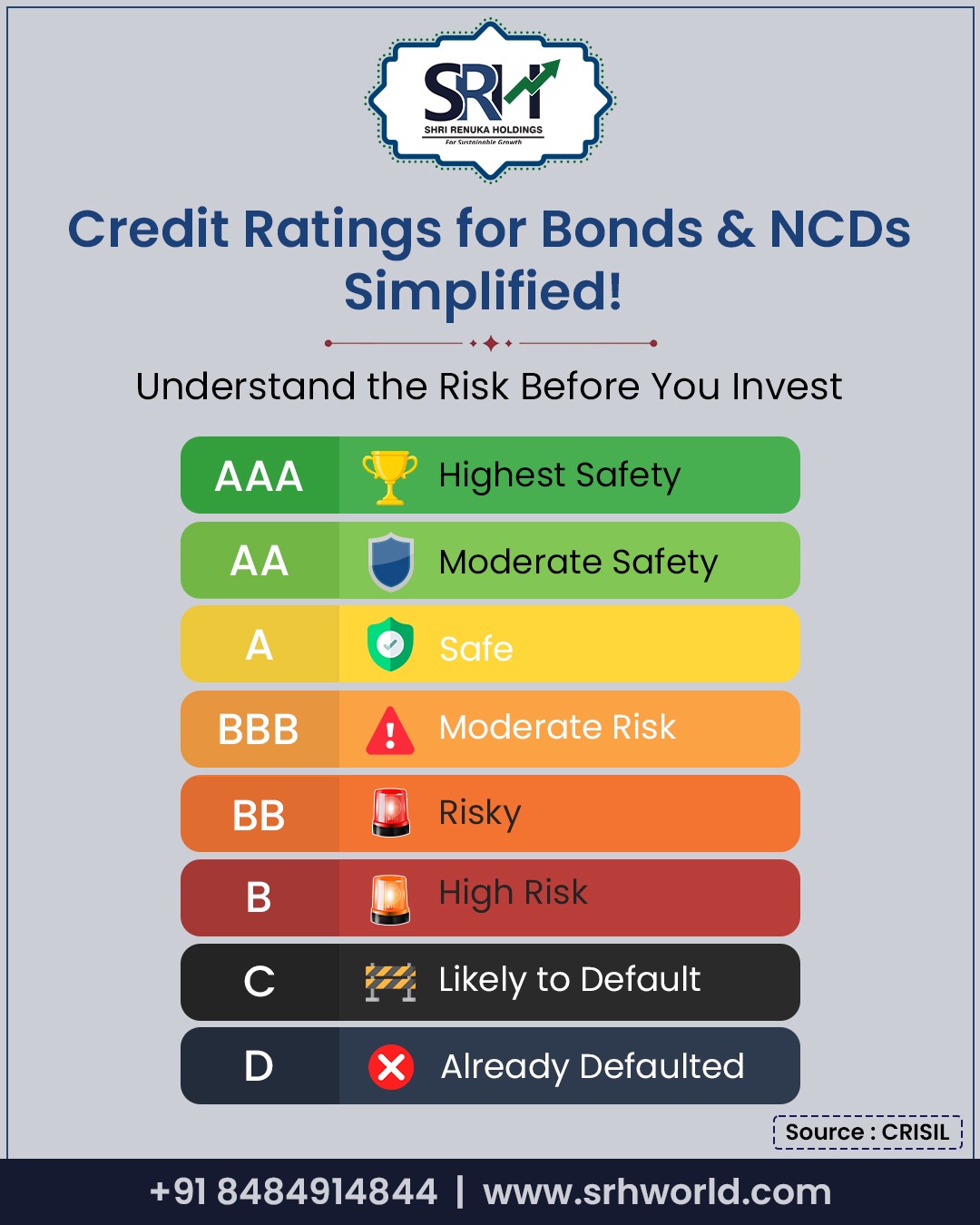
Decoding the Credit Rating Scale:
Investment Grade:
AAA - This is the gold standard for credit quality in India. Instruments with this rating are considered to have the highest degree of safety regarding timely payment. This rating is usually assigned to popular PSUs with strong government backing, major private sector companies with good track records.
AA – Instruments with this rating have a high degree of safety with very low credit risk. They are only marginally less secure than AAA rated instruments. Well established, strong corporations and institutions that are very stable but might not have the dominance of AAA rated companies receive this rating
A – This rating shows an adequate level of safety with low credit risk. These instruments could be somewhat susceptible to adverse economic or business conditions. Companies with good financial health, but operate in competitive markets or are as big as AA rated companies receive this rating
BBB – This is the lowest rating within the Investment Grade spectrum. Instruments in this category have moderate safety and moderate risk of default. Mid-sized, well managed companies or those that are in slightly more cyclical industries receive this rating.
Speculative Grade:
BB – This rating suggests a moderate risk of default. Issuer’s ability to meet financial obligations might be vulnerable, particularly under challenging business or economic conditions. Companies with high debt or operating in volatile markets get this rating.
B – Instruments rated B carry a high risk of default. Their capacity of timely payments is significantly vulnerable to changes in business environment. Companies facing financial strain or uncertainty get this rating.
C – This indicates a very high probability of default. The issuer is in financial distress and relies heavily on favourable conditions to meet its commitments. Companies nearing bankruptcy or debt re-structuring get this rating.
D – This rating signifies that the issuer has defaulted or is expected to default on its financial obligations. Companies which have missed payment on their debt receive this rating.
In conclusion, credit ratings provide an independent assessment of an issuer's ability to repay its debts. By recognizing the distinctions between investment speculative ratings, you can intelligently assess the investment risks and make informed decisions. To know more about Bonds, NCDs and their credit ratings, contact SRH or visit our website www.srhworld.com.
Our journey over 18 years
350 clients across the world
1080 complete projects
22 experts on board
Key Partners
































Connect with us
Helpline
+91 84849 14844
Landline
+91 (20) 24616106
info@srhworld.com